Showing posts with label fiction. Show all posts

8/19/2008

:: september is too far away ::

I'm a happy camper today. I pre-ordered Marilynne Robinson's novel, Home, which releases on September 2nd. (!)


From goodreads:

"Hundreds of thousands were enthralled by the luminous voice of John Ames in Gilead, Marilynne Robinson’s Pulitzer Prize–winning novel. Home is an entirely independent, deeply affecting novel that transpires concurrently in the same locale, this time in the household of Reverend Robert Boughton, Ames’s closest friend. Glory Boughton, aged thirty-eight, has returned to Gilead to care for her dying father. Soon her brother, Jack — the prodigal son of the family, gone for twenty years — comes home, too, looking for refuge and trying to make peace with a past littered with tormenting trouble and pain. Jack is one of the great characters in recent literature. A bad boy from childhood, an alcoholic who cannot hold a job, he is perpetually at odds with his surroundings and with his traditionalist father, though he remains Boughton’s most beloved child. Brilliant, lovable, and wayward, Jack forges an intense bond with Glory and engages painfully with Ames, his godfather and namesake. Home is a moving and healing book about families, family secrets, and the passing of the generations, about love and death and faith. It is Robinson’s greatest work, an unforgettable embodiment of the deepest and most universal emotions."

Anyone else geeked up along with me??

Also, thanks to Alissa, I'm reading this fantastic essay on Cosmic Realism, a literary style written by the likes of Annie Dillard and Marilynne Robinson. Great brain-food. Very inspiring.

8/01/2008

:: deadline ::


My first Curator article was due today and I met the deadline, yippee. Yesterday, I felt pretty good about the article. Today, not so much. I know this tension is every writer's dilemma, but since health issues sometimes interfere with my brain's function, I just hope the editor won't hate my writing. Gulp.

But I had plenty of visual/cranial fuel up in my cozy writing room:

[a good dictionary and Makoto Fujimura's book, River Grace (5/5 stars)]

[my bird-camouflage tote bag from Target. I use it to transport items up and down the stairs.]

[a nice, big window]

[pretty things. Our cat, Harley, attacked that iron bird a few days ago, totally thinking it was real.]

[a framed photo of baby-me and my grandmother, Nina, and a cool straw purse my Mom gave me (from The Blue Hand here in Houston - a shop to die for)]

[History of Art by H.W. Janson. I left it open like that due to the Rothko page on the right; I mentioned him in my article. That's de Kooning on the left there.]

[one of my favorite oversized books ~ Churches by Judith Dupré (introduction by Mario Botta). I snatched it from our coffee table because it contains a page on the Rothko Chapel which I also mentioned in my article.]

[another page in the book ~ Basilica San Marco in Venice, Italy. Seriously, Churches in America: get with the program.]

[yet another page ~ Borgund Stave Church in Borgund, Sogn, Norway. I love this Church because it whisks me away to one of my all-time favorite books, Kristin Lavransdatter by Sigrid Undset, set in medieval Norway.]

As for tonight, I'm gonna get lost in some reading and a cup of tea. Or watch a movie w/Johnny. Either way, time well spent.

7/27/2008

:: what i'm reading ::


-Walking on Water: Reflections on Faith & Art by Madeleine L'Engle.
-The Son of Laughter by Frederick Buechner (some of the best writing I've read in a long while).
-The newspaper.

I finished Makoto Fujimura's River Grace in one night. It's a short read, but 21 pages full of greatness - one to be read again and again.

I'm re-reading parts of The Quotidian Mysteries: Laundry, Liturgy, and "Women's Work". So good. One of my life-manuals.

I've also been reading fan-tastic quotes lately (thanks to goodreads), such as:

"The silence is all there is. It is the alpha and the omega, it is God's brooding over the face of the waters; it is the blinded note of the ten thousand things, the whine of wings. You take a step in the right direction to pray to this silence, and even to address the prayer to 'World.' Distinctions blur. Quit your tents. Pray without ceasing."
[-Annie Dillard]

"What a hideout: Holiness lies spread and borne over the surface of time and stuff like color."
[-Annie Dillard. I love her brain.]

"The writer should never be ashamed of staring. There is nothing that does not require his attention."
[-Flannery O'Connor. I love her brain, too.]

"If grace is so wonderful, why do we have such difficulty recognizing and accepting it? Maybe it's because grace is not gentle or made-to-order. It often comes disguised as loss, or failure, or unwelcome change."
[-Kathleen Norris. Need I say I love her brain?]

There were many others, then I ran across this amazing poem:

Manifesto: The Mad Farmer Liberation Front
by Wendell Berry

Love the quick profit, the annual raise,
vacation with pay. Want more
of everything ready-made. Be afraid
to know your neighbors and to die.
And you will have a window in your head.
Not even your future will be a mystery
any more. Your mind will be punched in a card
and shut away in a little drawer.
When they want you to buy something
they will call you. When they want you
to die for profit they will let you know.

So, friends, every day do something
that won't compute. Love the Lord.
Love the world. Work for nothing.
Take all that you have and be poor.
Love someone who does not deserve it.
Denounce the government and embrace
the flag. Hope to live in that free
republic for which it stands.
Give your approval to all you cannot
understand. Praise ignorance, for what man
has not encountered he has not destroyed.

Ask the questions that have no answers.
Invest in the millennium. Plant sequoias.
Say that your main crop is the forest
that you did not plant,
that you will not live to harvest.
Say that the leaves are harvested
when they have rotted into the mold.
Call that profit. Prophesy such returns.

Put your faith in the two inches of humus
that will build under the trees
every thousand years.
Listen to carrion - put your ear
close, and hear the faint chattering
of the songs that are to come.
Expect the end of the world. Laugh.
Laughter is immeasurable. Be joyful
though you have considered all the facts.
So long as women do not go cheap
for power, please women more than men.
Ask yourself: Will this satisfy
a woman satisfied to bear a child?
Will this disturb the sleep
of a woman near to giving birth?

Go with your love to the fields.
Lie down in the shade. Rest your head
in her lap. Swear allegiance
to what is nighest your thoughts.
As soon as the generals and the politicos
can predict the motions of your mind,
lose it. Leave it as a sign
to mark the false trail, the way
you didn't go. Be like the fox
who makes more tracks than necessary,
some in the wrong direction.
Practice resurrection
.

7/11/2008

:: a poem ~ normal ::


Last night my husband and I watched the first half of The Assassination of Jesse James by the Coward Robert Ford. We'll finish the movie tonight, but so far we are very impressed with the cinematography; and Casey Affleck's, Brad Pitt's, and Paul Schneider's acting. In fact, I really think Pitt should've received an Oscar nomination along with Affleck.

This morning I remembered the movie is based on a novel of the same name by Ron Hansen. I read Hansen's Mariette in Ecstasy a few years ago and liked it for the most part (4/5 stars). I also recalled that a back issue of IMAGE - #57 - contained an interview with Ron Hansen. I skimmed the Q & A, and now I want to read The Assassination of Jesse James, Atticus, Exiles, Hitler's Niece, and A Stay Against Confusion: Essays on Faith and Fiction.... I just have a feeling that Ron Hansen will be one of my favorite writers. My literary hunches are usually correct.

As I flipped through IMAGE #57, I discovered the following poem. It is worth sharing:

Normal
by Richard Jones

Tent Revival, 1957

When things get back to normal
God will put on black robes
and ascend to the mercy seat
to judge the world, the ruined
cities, the devastated hills,
the living and the risen dead.
When things get back to normal,
He'll open the Book of Life
and read what each man has done,
said, and written, reciting our words
and deeds to the angels to see
if there is any forgiveness
like honey on our tongues.
When things get back to normal
all will stand before God
and be burned like dead branches
or blessed with the incomprehensible fire
of mercy. When things get back to normal,
we will be standing on the threshold of heaven,
a kingdom of singing where at last we will learn
the meaning and purpose
of poetry
.

7/01/2008

:: slow reading ::


I loved Peggy Rosenthal's blog entry about slow reading over on Good Letters. You see, though I read a lot, and often many different books & periodicals at the same time, I'm a slow reader. God made me this way, and also, I simply enjoy reading slow. I do read some books faster than others, but more often than not, I take my time - soak in the words, the sentences, the story, the visuals, the ideas, and so on.

A long time ago, I worried that my slow reading made me dumb or of a low intellect. But in the fourth grade, I was placed in an advanced reading class. I felt all special because I got to visit a fifth grade classroom every week, huddle around a wooden table with a few other advanced classmates, and learn along with older kids. I suppose if I was "so dumb" those teachers wouldn't have selected me for such a class.

In more recent years, I read an article by an author (I wish I could remember....) who basically said that good writers learn from what they read, so they ought to take it slow - not scarf down a book like a fast food meal. Allow the book to nurture you, feed you. That cheered my writer-wannabe soul.

All of that to say, I've enjoyed the art of slow reading this week:

-I had trouble reading The Maytrees a few months ago. This greatly troubled me because Annie Dillard is one of my all-time favorite writers. Pilgrim at Tinker Creek changed my life. After reading Rosenthal's blog entry in which she mentions The Maytrees, I figured out that I was trying to sprint through the book instead of savoring. I am almost finished and now that I've slowed down, I'm in awe of Dillard's writing once again. Her way with words is precisely why I joined the facebook group, "If Annie Dillard writes it, I will read it."

-Much to my happiness, the July/Aug. 2008 issue of Poetry arrived. Have I mentioned that I love when a poem complements the weather going on outside our windows? Houston has been quite rainy and stormy the past week, yet the sun shines today. I found the following poem to be lovely:

The Storm is Over
by Jason Guriel

But now it's raining
below the greener clouds
of trees that were absorbent
but only up to a point.
And these raindrops
strained by treetops
should (you would think)
be filtered and finer
and therefore pure
(and not Chinese
water torture's
fatter, darker drops
that always pick out
of all possible bull's-eyes
your bald spot).
But these are late, last drops
and a little bloated
like late, last poems
by name your poet
.

[that poem is fun to read aloud ~ most of it sounds exactly like the aftermath of rain]

-My friend Matt kindly sent us a subscription to The Sun. I used to subscribe to this magazine full of beautiful photography, interviews, essays & memoirs, short stories, poetry, liberal politics (I'm conservative), and the Readers Write section - I mean to contribute one of these days. But I chose not to renew my subscription last time to save a few bucks. So you can imagine my wide smile when I discovered Matt's gift in our mailbox! Issue 391 contains an interview with the great Wendell Berry. His brain fascinates me. I didn't agree with everything he said, though he is full of wisdom. I loved this quote:

"Real reading, of course, is a kind of work. But it's lovely work. To read well, you have to respond actively to what the writer's saying. You can't just lie there on the couch and let it pour over you. You may have to read with a pencil in hand and underline passages and write notes in the margins. The poet John Milton understood that the best readers are rare. He prayed to his muse that he might a 'fit audience find, though few.'"

-My friend Brett urged me to read Hinds' Feet on High Places - one of her favorite books. At first, I didn't want to because I decided it wasn't "my kind" of book. But I trust Brett implicitly, so I read a few pages of the Christian allegory, read a few more pages, and then I was hooked. I totally relate to the character "Much-Afraid." Not only that, but I realized with horror that at times, I might be a literary snob! I can't have that. Hinds' Feet is turning out to be both a good read for adults, and one I'd love to read to my future children.

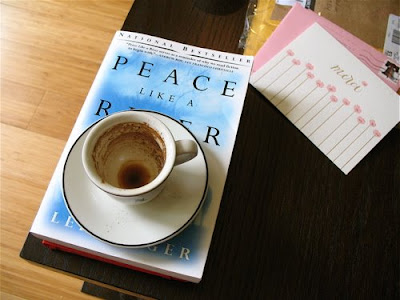
-Oh, and the above photo is my end table next to the upstairs sofa (I love Audrey Hepburn movies). Here is my husband's end table with one of his heroes:

[the coasters are gifts from my Mom-in-law]

6/29/2008

:: siringo ::

Well, I finished So Brave, Young, and Handsome, and just as I expected, I fell in love with Leif Enger's characters once again. I will admit this book starts out slower than Peace Like a River, but I promise that if you stick with it, you'll be hard-pressed to put the book down, dying to know just how Glendon's and Monte's journey ends.

As I read So Brave, Young, and Handsome, I was thrilled to find a subtle nod to Peace Like a River in this description of Charles Siringo:

"His sentiments for the most part were vengeful and emerged from experiences so long at a simmer that he spoke in what amounted to strong verse about those who had wronged him. I was surprised to learn he had been fired by the Pinkerton Agency years before; he gave an eloquent screed on the decayed character of Allan Pinkerton, whose 'spine went missing at birth.' To a cowardly pard who had fled gunfire he gave a scorching epitaph. Strangely his softest words were for certain of the outlaws he had hunted: Butch Cassidy, whom he never saw in the flesh through four years of pursuit; the surgeon and gentleman gunsmith Howard Cawley, whose talent for baking cinnamon rolls made him welcome at Hole in the Wall; and Glendon, whom Siringo referred to as 'that gentle bastard.'"
[pages 148-149]

I think Leif Enger should share the exact cinnamon roll recipe, don't you?

And, I'm proud to say that my husband is finally reading Peace Like a River (after I bugged him to death). He now understands why I'm so geeked up about Enger's stories. Johnny is reading quite fast, and loves Swede's poems.

6/21/2008

:: bookish podcasts ::

I do love a good podcast, especially if it involves the arts. I like to listen in our home while sipping tea, cleaning, or resting my eyes. Or load up my iPod for driving around town. I don't know about your locale, but Houston radio sucks other than KUHF which features many NPR broadcasts. Even then, it's hard to catch those programs at the right time, so podcasts are much more convenient.

Seeing as this blog revolves around all things literary, I thought it would be a good idea to list my favorite bookish podcasts, for you fellow listeners:

-The Writer's Almanac.
-The New York Times Book Review.
-Audition (from Mars Hill Audio).
-NPR's Fresh Air. This is one of my favorite podcasts in general, and Terry Gross often interviews great authors.
-NPR's Book Tour. Alissa hipped me to this one, specifically because it's all about Leif Enger this week. He talks about writing Peace Like a River, reads from his newest book - So Brave, Young, and Handsome - etc.. It is time well spent.
-Lindsay mentioned the Poetry Foundation's Poetry Off the Shelf which I now love, and then I discovered that the P.F. offers several other poetry-related podcasts. Oh, goodie.

I get terribly behind on my podcast-listening, but it's good to know they're around, for my ears' sake.

Do you have a favorite bookish podcast you'd like to share?

5/31/2008

:: waiting for september ::

After you fall in love with Housekeeping and Gilead, y'all can join my excitement over something I read yesterday.... A new Marilynne Robinson novel will be published in September 2008! I read on Wikipedia (and elsewhere), "Home is a companion piece to Gilead, focusing on the Boughton family during the same time period that Gilead covers."

Normally, I'd be nervous if an author tried to follow up such a rich story as Gilead, but I trust Marilynne Robinson, much like I trust Leif Enger. I loved Gilead so much that with confidence in this author, I'm excited to be reacquainted with the Boughton family. And I'm [selfishly] relieved that Robinson did not wait another 20 (or so) years to write her 3rd novel. God is good.

FYI, Marilynne Robinson also wrote two books of essays. I own a copy of The Death of Adam, sitting on a shelf upstairs, but I haven't read it yet. Will soon.


P.S. - [on my other blog, read towards the end of "she & him (and more)" and "upstairs" to see how musician Lori Chaffer persuaded me to read J.D. Salinger's Franny and Zooey ASAP, and actress/musician Zooey Deschanel did likewise with Ernest Hemingway's A Moveable Feast. There's so much to read in the world.]

5/28/2008

:: marilynne robinson interview ::

The Rabbit Room (one of my favorite blogs) posted an NPR interview with Marilynne Robinson (one of my favorite authors). Terry Gross asked Robinson about her second novel, Gilead. The interview is a worthwhile listen, and you already know I believe Gilead is a must-read book.

But did you know that Marilynne Robinson and I share the same birth date - November 26th? I think that's important somehow.

5/27/2008

:: it's getting good ::

I liked So Brave, Young, and Handsome straight away, but late last night, around page 37, I thought, "Uh oh. Leif Enger did it again. How will I ever be able to put this book down?" Since I was weary to the bone, I found a way, but needless to say, whatever Enger writes - be it the phone book, grocery lists, etc. - I will read it.

Here's one quote that I read over and over, just for the sheer beauty:

"And so I rose each day and dipped my nib. I filled my hopeless quota. I was the Dickensian halfwit who composes letters by the hour, only to make them into kites and fly them up to God."
[page 22]

And, here's a description I found to be charming:

"It pleased Glendon to make shiny inlaid sections in the small foredeck of his Dobie Swifts. He generally shaped copper or bronze to the profile of a bird in flight - aglow with polish, they were pretty and simple as sonnets."
[page 26]

To entice you a little further, some of the character's names (so far) are Monte Becket, his wife Susannah, Redstart (their son), and Glendon Hale. It's fun to meet new characters, huh? Leif Enger's second book is getting good, folks.

And oh, yeah - the ending of Christ the Lord: the Road to Cana choked me up. Anne Rice did it again, too. Andrea, you gotta read it ASAP so I can say more. No pressure.

5/24/2008

:: a keeper ::

I'm not finished with Christ the Lord: the Road to Cana yet, thank God. The only problem with a great book is the last page; I hate for such a good story to end. I love Anne Rice's imagination. I don't want to give anything away, especially since Andrea is planning to read The Road to Cana, but apparently, there's some controversy regarding the character of Avigail. However, that story line is choking me up with a beautiful parallel of how Christ loves the Church. Again, Anne Rice is brilliant.

Though I'm still immersed in Cana, I do know what my next fiction read will be. Last night, Johnny and I met my brother for Greek food - a good enough time in and of itself. But I was itching to wander around a bookstore w/coffee in hand. This should not surprise you. We visited one of my favorite stores in Houston: Bookstop, an old, renovated movie theater. I sipped an Americano - my new favorite drink.

In my defense, we did buy birthday gifts for two of our friends. And then, I walked by a display table of new, hardback fiction. You know what I saw ~ So Brave, Young, and Handsome by Leif Enger. It was 20% off, and I'm thankful my husband understands there are some books you simply must own. Besides, we want to pass down the best books to our [future] children (hence the name of this blog). I'm even more satisfied we spent money at Bookstop since there's talk of tearing it down - one of the most beautiful spaces in Houston. I'd make a purchase at Bookstop every week if it would do anything to save the historic landmark.

....I'll let you know how great Leif Enger's new novel is soon.

[a coconut milk latte w/cinnamon. I know what you're thinking, but it tasted great; like real milk. I swear. Hey, if you were dairy-deprived for several months, you'd try it, too.]

5/22/2008

:: a new book ::

[coconut black tea there]

It's tough to follow up a book like Peace Like a River, but for an avid reader such as myself, it had to be done. I like to have both a fiction and non-fiction book going at all times. As for fiction, I pulled Christ the Lord: the Road to Cana off the shelf a few days ago, and since then, it's been very hard to put it down.

Selecting that book was not a hard choice. For one thing, I loved Christ the Lord: Out of Egypt. Both of Anne Rice's Christ the Lord books are pretty astounding. She honors Scripture within fiction, writes beautifully, and presents history accurately. As for how she describes Jesus - brilliant. Perhaps it seems controversial, but who hasn't sat around, imagining what Jesus was like - as a child, growing up, obeying Joseph & Mary, working as a carpenter, and all the while never sinning? We have a great account of Jesus in the Bible, of course, but I don't see any harm in using our God-given imaginations, as long as Scripture is not contradicted.

The Road to Cana was also an easy choice because my husband "oooh"-ed and "ah"-ed out loud when he read it last month. We usually read together in the living room at night. I sit in my spot on the couch sipping tea, and Johnny sits in a chair across the room sipping a martini (or Scotch). We get absorbed in whatever we're reading, and if we are impressed, we'll often say, "Hey, can I read you something real quick?" This annoys both of us, yet we continue to bug each other.

Last month, Johnny was convincing enough that Anne Rice's new book is making me "oooh" and "ah," too. I'm determined to persuade him to read Peace Like a River ASAP, but he keeps reminding me that he's reading a good book about Stonewall Jackson (by George Grant). I love Stonewall Jackson as much as the next guy, but please, tell my husband I'm right. I can't keep my mouth shut about Leif Enger's story much longer, and I gotta know Johnny's opinions!

Anyway, I might share more thoughts when I'm done w/The Road to Cana, but if you're curious, go ahead and read both "Jesus books." They're absolutely beautiful.

And if you're wondering, yes, I did read one of Anne Rice's vampire books: Vittorio the Vampire. It's not my preferred genre, but that book was great; it even had a quote by St. Augustine and a few redemptive elements. I liked the film Interview with a Vampire, too. So there.

What are y'all reading now that Leif Enger is out of your life (or is he)?

:: peace like a river - movie? ::

Well, it seems that Peace Like a River will be made into a movie in 2009 or so. I'm not sure how I feel about this. I'm nervous.

I've seen some good book-adaptation films; I was recently very pleased with The Kite Runner, for example. But I think we all agree that the Peace Like a River movie better honor the book, to the highest degree. Right? If this film is done well, I'd love to see it on the big screen.

The only cast member listed is Billy Bob Thornton. Interesting.... Who do you think he will play? Which actors should portray the other characters??

5/21/2008

:: the end [major spoilers] ::

[after I finished yet another espresso w/cinnamon this morning. However, as I typed this entry, I sipped rooibos caramel tea.]

I don't have the brain power to write an eloquent summation of Peace Like a River's grandeur. Not today. In order to do that, I'll need to read it again during a better health phase of my life. And believe me, I will read this novel again. It's one of those books where I set it down, and felt like I said goodbye to real, lifelong friends. Those friends being Reuben, Swede, and Davy. Yes, even Davy who I didn't understand one lick. But I want to know, did Davy believe Reuben's account of Heaven? Jeremiah's transformation and bliss? Did Davy ever see his sister again? Things like that.

Before I try in vain to praise the last two beautiful chapters of Peace Like a River, let me tell you in brief what I loved from pages 205 'til the end:

-Reuben seeing Davy on a horse, and sneaking out to meet him. I loved that reunion of the two brothers. It gave me assurance that though Davy was complicated, he loved his family. A lot.
-How Jeremiah prayed/argued/wrestled with God over Andreeson, and how Roxanna believed that supernatural scene. And, how God showed Jeremiah Who's boss, and Jeremiah eventually complied, torn shirt and all.
[I'll say here that I never, ever liked Jape Waltzer. He gave me the creeps, and I squirmed every time he showed up on a page. I felt sorry for Sara, too. And I wanted to smack Davy upside the head for trusting Jape at all.]
-The courting of Jeremiah and Roxanna. Jeremiah moved out to the Airstream ~ what integrity. That, my friends, is a real man. Thank God, those two got married! The romantic in me sighed with relief.
-This interchange between Jeremiah and Reuben (in reference to Andreeson):

"'Love your enemies,' Dad said. 'Pray for those who persecute you.'
He would pick those verses.
'Rats, huh?' he said
."
[page 246]

-Reuben's sudden concern for Andreeson, realizing that evil Jape would kill him.
-The entire repentant prayer of Reuben Land on pages 285-286. Like this excerpt:

"....weeping seems to accompany repentance most times. No wonder. Could you reach deep in yourself to locate that organ containing delusions about your general size in the world - could you lay hold of this and dredge it from your chest and look it over in daylight - well, it's no wonder people would rather not."

-These quotes, too:

"One thing I wasn't waiting for was a miracle.

I don't like to admit it. Shouldn't that be the last thing you release: the hope that the Lord God, touched in His heart by your particular impasse among all others, will reach down and do that work none else can accomplish - straighten the twist, clear the oozing sore, open the lungs? Who knew better than I that such holy stuff occurs? Who had more reason to hope
?"
[page 292]

"Listening to Dad's guitar, halting yet lovely in the search for phrasing, I thought: Fair is whatever God wants to do."
[page 294. This particular quote speaks to me loudly.]

And then, the shootings. Breathless, I thought, "Jape! Of course. Crap."

Early on in the book, I thought Jeremiah might eventually die, though every time that idea came up, I dismissed it quickly, not wanting to believe. One such time was that first miracle: Jeremiah walking on air, praying for Reuben. Or like Andrea said, when Jeremiah told Reuben he'd take his place if he could (I think all great Dads think this way). I did not want Jeremiah to die one bit. But here's the thing about Christians & death.... Death is always grueling - it is a vicious ripping - but there is sweetness to be found.

The most recent familial death I've dealt with is my grandfather - Papaw. When I first heard the news, my heart sank like a rock to the pit of my soul. He was my hero. But now, I often picture him healthy, strong, and near Jesus' side - where Papaw always wanted to be. Sometimes it feels as if I get a real glimpse of some sort, or I can feel my grandfather's joy, and then I catch myself smiling.

I'm not sure who else has been ambitious enough to try and describe eternity - "the next country" - but in my opinion, Leif Enger nailed it, as much as humanly possible.

"At that moment I had no notion of identity. Nor of burden. I laughed in place of language. The meadow hummed as though thick with the nests of waking creatures, and the grasses were canyon colored, lifting their heads as I passed. Moving up from the river the humming began to swell - it was magnetic, a sound uncurling into song and light and even a scent, which was like earth, and I must've then entered the region of nests, for up scattered finches and cheeky longspurs and every sort of bunting and bobolink and piebald tanager."
[page 300. I love how this man writes.]

"Here in the orchard I had a glimmer of origin: Adam, I thought. Only the bare word. It suggested nothing. It was but a pair of syllables that seemed to belong to me."
[page 301]

And by the way, I loved the personification of nature in that next country. Its rhythm and humming. Don't you sometimes see it hinted in swaying trees on the prettiest days? I do.

I loved Jeremiah running up to Reuben - Jeremiah's incandescent face laughing, noting his son's muscular, grown body. I loved how they ran together, not tiring.

"We were like two friends, and I saw that he was proud of me, that he knew me better than he'd ever thought to and was not dismayed by the knowledge; and even as I wondered at his ageless face, so clear and at home, his eyes owned up to some small regret, for he knew a thing I didn't."
[page 303]

"'Take care of Swede,' Dad said....
'Work for Roxanna,' Dad told me....
'Tell Davy,' Dad said."
[page 304. Those lines nearly choke me up every time.]

And did you notice, Reuben wanted to go with his Dad to that beautiful city, not back to the earthly country? But a final, incredulous miracle had occurred. Though Jeremiah's shot wounds should not have killed him, they did. Though Reuben's bullet-shredded lungs should have ended his life, they did not. I believe God granted another prayer of his saint Jeremiah - to trade his life for his son's. And with Reuben's life restored, so were his lungs. Glory be.

One more thing about "the next country." To me, it was a direct contrast to the skin bag man's country. In that land of fright, all is stark, dry, and gray. Reuben's breath was stolen from him. But in "the next country," all is lush, verdant, and creation sings. There, Rube's breath is restored, his lungs healed.

And, the second time Reuben unwillingly visits the skin bag man's country [page 237], Jape is likened to that devilish breath-stealing creature. I do believe Jape is the exact opposite of Jeremiah Land. Jape has no faith, and wants to do everything on his own terms (maybe his main appeal to Davy). Nor does he have Davy's best interests in mind. He even tries to kill Reuben. Jeremiah, of course, spills over with radiant faith and the best of intentions - true love - for each of his children. He does the Lord's bidding. He trades his life for Reuben's. These comparisons just came to me today - did y'all see them as well?

So no, I did not want Jeremiah Land to die. I didn't want Roxanna to be a widow. But I loved how she remained part of the family; very much the childrens' mother. I loved Swede's [expected] literary success. And I loved how Reuben and Sara ended up husband & wife, w/children. I did not see that coming, but again, my romantic side swelled with happiness. Of course they belong together.

Yet after all that, Davy still remained distant; both physically and in regards to faith. This bothered me more than Jeremiah's death in a way. We know where Jeremiah runs and how right it is (though bittersweet). But where is Davy running? Did he ever finally believe and relinquish control?

We'll never know, I suppose. But like Reuben said:

"Belief is a hard thing to gauge where Davy is concerned."
[page 310]

"Is there a single person on whom I can press belief?
No sir.
All I can do is say, Here's how it went. Here's what I saw.
I've been there and am going back.
Make of it what you will
."
[the end]

5/20/2008

:: confession, and a change ::

[a photo repeat from my other blog, in a post about reading]

I must be honest with y'all ~ during my stomach virus, I finished Peace Like a River. And oh, how I loved it! In fact, I loved the last two chapters so much that I read them 2-3 times. I've never read anything quite like this book. I have a hunch that each of you finished Peace Like a River, too. Am I correct?

I ask because I cannot finish this book discussion in the manner I've been posting all along. My health issues are so odd. I'll feel pretty good for a few days, then I'll sleep horribly or whatever and feel like utter crap all over. The book discussion has been a fun experiment, but it's actually been very hard for me to keep up with. And, I feel like the discussion fizzled out for the most part. These things happen; I do understand.

So, if y'all have finished the book, I'd say let's talk about the ending, and anything leading up to it that you found significant. What do you say?

I'm also pondering what exactly to do with books for calvin. I'm keeping this blog for sure, but it's about to change into a reading & writing blog of sorts.... All things literary, from an aspiring writer's perspective. I will not outright copy Robin's lovely blog - The Wonderful Pen - but I'm thinking I will share:

-quotes from books I'm reading,
-some thoughts,
-author interviews,
-writing advice quotes,
-poems,
-book reviews,
-giveaways,
-reading/writing photos,
-local bookstore adventures,
-etc.

I'll leave the comments open ~ if any of you love all things bookish as much as I do, I'd love to read your thoughts!

Thank you for taking part in the discussion so far, and your patience with me. Who knows, maybe when my health is consistently stronger, we can try another discussion. We shall see.

5/14/2008

:: leif enger audio ::

For your listening pleasure:


Enger mostly discusses his new novel - So Brave, Young, and Handsome - which I'm dying to read soon.

Happy listening.

:: peace like a river/pages 180-222 - picnic ::

The picnic scene was also vivid in my imagination, and very magical. Yet another reason to love Roxanna - she knew exactly where to have a bountiful picnic in the dead of a North Dakota winter, yet stay warm. That, and her great uncle knew Butch Cassidy (short of quoting the whole story, I had to at least mention it).

Really, though, I adored the writing on pages 198-199:

"....and so we climbed, topping the hill at last to look down at what seemed a garden of fire.

Fire, and rising steam, and specks of light - the specks pooling and runneling then blinking out to be replaced by others. The fire came from a split in the earth that had opened and zigzagged away through the hills. .... No, I didn't think it was the genuine Hell; it was way too pretty. .... No doubt Voltaire had a moment or two of deep regret before departing into that country - I know
I was nervous - but down we went, descending the hillside lit by orange snow.... 'Roxanna,' Dad said, it's a miraculous place. I never saw better.' He was sitting beside her. The firelight had restored his face to healthy color and she, all Frenchbraided, scarf unslung, resembled an opportunity missed by Rembrandt."

And then, that pesky Andreeson showed up, in the midst of all that magic. Talk about a downer. However, it was quite the interesting exchange between he and Jeremiah. And I loved how Roxanna immediately, and silently, took sides with Davy, though she'd never met him. I also loved when Reuben described M. Andreeson as "the king of pukes." [page 204]

But Reuben asked the same questions that formed in my mind: if Andreeson was so close to Davy in the Badlands, why was the putrid fed so desperate for Jeremiah's supernatural help? "Spookism," as the kids called it. Is Andreeson admitting defeat thus far? And why didn't he arrest the Land family? It makes me think he's not all bad, as much as we might like to think. Everyone has to do their job, after all, and Davy did commit murder.

Oh. To backtrack a little.... That blizzard - the one that kept the Land family happily stuck at Roxanna's house - do you think that was one of Jeremiah's miracles? I know that Reuben said it was "the work of providence," [page 187], and I know that early on we distinguished a miracle from an every day, faithful, beautiful act of God, but that blizzard did seem miraculous to me. It hid the Land family from the police's eyes, Roxanna owned a barn big enough to hide the Airstream, she kindly provided rooms & meals for the weary travelers, and she was so much like a Mom to the kids it wasn't even funny. It seemed to me that God hid this family and favored Jeremiah once again. So, miracle, or just another cycle of weather by God's design?

:: peace like a river/pages 180-222 - devil ::

["Man on a Swing" by Francisco Goya, courtesy of The Frick Collection]

I've said before that I was a minor asthmatic as a child, and somewhat in my 20's. Reuben is a pretty severe asthmatic, but even so, when he describes what it feels like not to breathe, my lungs hurt with remembrance.

"I dreamed a devilish little man came and stole my breath. He stepped through the door with a skin bag strung limp over his shoulder and with dispassionate efficiency crouched back and slugged me in the stomach. Such an incredulous exhale! And so complete; not a wisp of air remained. .... The little man crouched again and looked at me closely. He was a pale one, a horror. Years later I would describe him to Swede and she would point him out to me, or his close cousin, in a book containing the works of Francisco Goya."
[page 183]

To me, that was some of the most vivid imagery in the whole book. And evil imagery, I might add. I know Reuben dreamt it, but with his Dad's supernatural abilities and all, I stopped to wonder if Reuben actually caught a glimpse of an evil spirit. Especially since he later pointed out the devilish little man's cousin in a Goya lineup. But describing how no more breath could be found in his lungs; how Jeremiah prayed for him bedside, Roxanna whacked, and Swede cried - it sounded like a very dire situation.

I don't recall Reuben ever falling into depression after his asthma until then. The next day, he wakened to utter fatigue, shallow breath, and Roxanna & his family outside in the gleaming, white snow. He felt abandoned. His thoughts seemed very dark:

"I crawled back in bed under the weight of the sun and joy and adventure happening outdoors, and I thought dangerous things to myself. Back to mind came every hurt I'd endured for my defect, every awaited thing I'd missed. It seemed to me such wrongs were legion in my short life. It seemed that I'd been left alone here by the callousness of my family; that should the man with the skin bag return I might not fight so hard next time; that this house was so empty even God was not inside it. He was out there with the others, having fun."
[page 185]

But after such a horrific dream and serious asthma attack, I can understand his dark thoughts. Whether you struggle with a long-term illness as a child or in adulthood, I do think there comes a time (even to the most saintly) when you feel as if God has abandoned you. You know better, you remember Scripture saying otherwise, yet try as you might, it feels like God isn't listening anymore. Like He skipped town. As y'all know, I'm dealing with several health issues which I do believe God is healing, but very slowly. I'm ashamed to admit that I've frowned often, complained, and wondered where in the heck God was (when He was right there).

And then I realized, I relate the most to Reuben in this book. I'm not exactly sure why; he's a boy, after all. One thing I've concluded is that I watch everyone like he does; quite intently. But I do relate to this young man, and I'm wondering, do y'all relate to a particular character? Why?

:: peace like a river/pages 180-222 - beauty ::

[my drink of the week is espresso w/cinnamon]

As I read these pages, I discovered beauty. Mainly in Roxanna, who (whom?) I adored right along with Reuben and Swede. I'm not sure where to begin with Roxanna ~ her dry sense of humor, the way she nursed goats with a baby bottle, her instant rapport with Swede, her warm hospitality, her great uncle's cinnamon roll recipe (that icing!), the way she whacked Reuben's asthmatic back - like she was already part of the family somehow. She was a hardworking, kind, and independent woman.

But I thought Reuben's perceptions of Roxanna were fascinating. First, he stated, "I'm ashamed to recall thinking it was too bad Roxanna Cawley was not lovely." [pages 182-183] However, after spending some time in her house and feeling quite at home, Reuben witnessed this beautiful passage (and yes, I'm gonna type out every word):

"'Children,' Roxanna replied, turning to us. Though her eyes glittered she was not crying; in fact she pulled a smile from somewhere. Her hair was roped back in a French braid from which it was very winningly coming loose, and she held before her a picnic basket with a clasped lid. For heartening sights nothing beats a well-packed picnic basket. One so full it creaks. One carried by a lady you would walk on tacks for. Does all this make her sound beautiful to you? Because she was - oh, yes. Though she hadn't seemed so to me a week before, when she turned and faced us I was confused at her beauty and could only scratch and look down at my shoetops, as the dumbfounded have done through the centuries. Swede was wordless too, though later in an epic fervor she would render into verse Roxanna's moment of transfiguration. I like the phrase, which hasn't been thrown around that much since the High Renaissance, but truly I suppose that moment had been gaining on us, secretly, like a new piece of music played while you sleep. One day you hear it - a strange song, yet one you know by heart."
[page 196]

All of this did make Roxanna sound beautiful to me, but honestly, I already thought she was lovely. There was just something about her, and Jeremiah's early opinion of her - how at ease he sat at her table that first night, leaning back in his chair, tired & pleased. Even Rube observed:

"To Dad - so long without his wife - the particular formula of a meal, woman, and conversation must have seemed like a favorite hymn remembered."
[page 182]

The romantic in me burst out. I wanted nothing more than for this crew to end up as a real family. It was more than obvious that Swede & Reuben had fallen head over heels in love with Roxanna, but I kept trying to figure out, had Jeremiah? In my opinion, he respected her immensely. And coming from him, I knew for sure she was a great woman. But as for romance, Jeremiah seemed guarded. My inner-romantic kept hoping that love would bloom between this man and woman.

To tie this all up, I want to know - have you met people like Roxanna? Ones that society would deem homely, yet to you, and to many, they are Greek gods/goddesses? My Mom always told me it's more important to be prettier on the inside, and as cliche as that still sounds, I really believe it is true (thanks, Mom). Every time I conjure Roxanna's character, I do see a gorgeous woman; one I'd prefer over a runway model any day.

Also, help me out here.... I should know more about the play Cyrano de Bergerac than I do (please don't tell my high school English teacher) - but I believe Leif Enger's Roxanna is a twist on the classic drama of talented poet & big-nosed Cyrano and the beautiful woman he loved, Roxanne. Your opinions?

5/03/2008

:: peace like a river/pages 129-179 - airstream ::

1. I forgot to ask one question while the Land family were still at August & Birdie's house. Why did Jeremiah fall silent upon hearing about his childhood bedroom from Reuben? [page 148] I've been thinking about that. It made me wonder if Jeremiah's childhood was not idyllic. Did that cross your mind?

2. I laughed as I pictured Swede astride her saddle, on a sawhorse, in the Airstream trailer's kitchen; typing out their journey in dramatic Western prose. That Swede is a hoot! Jeremiah really is a saint to allow her to bring along a saddle, a sawhorse, and a typewriter. My Dad is a great man, but in answer to Reuben's question on page 149, no, I don't think my father would have gone along with such a plan.

3. I found the following quote to be very powerful, as Reuben realized they really were alone, on the run from Andreeson and the North Dakota cops:

"And so still were these men, and so unmoved in their faces, and so flatout many were they, dispersed like hunters across a field, that I knew they were indeed looking for us, and for Davy through us. At once I took a fierce chill. A sob rippled up my throat and I couldn't do a thing about it. It sure is one thing to say you're at war with this whole world and stick your chest out believing it, but when the world shows up with its crushing numbers and its predatory knowledge, it is another thing completely. I shut my eyes and rocked."
[page 165-166]

Reuben sure does feel things very deeply, doesn't he?

4. I've been missing a good miracle. However, as the Land family were on the run from all those cops at each gas station, even I chose not to see the miracle. I kept thinking, "Wow. How are all those cops missing a green Plymouth wagon and a 20-foot Airstream trailer whizzing by?" Then, of course, when Reuben explained,

"They didn't get us, though; not one of them even saw us, though we saw them, as I've described; we tiptoed through that town like a fat boy through a wolf pack. Make of it what you will."
[page 167]

I said aloud, "OH. Of course." I was also intrigued that God allowed this particular miracle; as if He wanted Jeremiah to find his son. You know? Swede's reaction to witnessing her first Jeremiah-miracle was interesting, too. She dramatically likened her Dad to Moses and other Old Testament prophets, which is somewhat accurate, in my opinion. But then she missed the healing of her saddle's leather, all that time. Reuben had to point out that miracle to her, though she'd used her saddle often since Jeremiah made it like new. Which brings me to another great quote:

"It's been this part folks disbelieve - not that the saddle was made whole but that Swede had gone all this time without seeing it. Odd on the face of it, I know - I know. But we're fearful people, the best of us. We see a newborn moth unwrapping itself and announce, Look, children, a miracle! But let an irreversible wound be knit back to seamlessness? We won't even see it, though we look at it every day."
[pages 173-174]

That's another profound statement about miracles. I mean, if you really think about it, if you saw an actual miracle, it would scare the pants off you, right? That's how it would be for me; at least instill the true fear of God within my soul. I'm so used to the everyday rhythm of things - living after the Fall - that if some event contradicted the earth, I might lose my breath, or like Swede w/the saddle, miss it entirely.

I wonder what made her recognize that Jeremiah shielded their entourage from the policemen's eyes, though? That she was so enthralled with her part in escaping Andreeson (i.e. maple syrup)? She loved the drama of outrunning the police, but realized full well they shouldn't have been able to?

5. One last thing: I thought Reuben's and Swede's conversation about the Old Testament prophets was hilarious. That's all.

What did y'all find significant within these pages?